The AI Training Program
DAML's structured entry point into ML engineering, from intuition and metrics through deep learning, transformers, generative models, and agents.
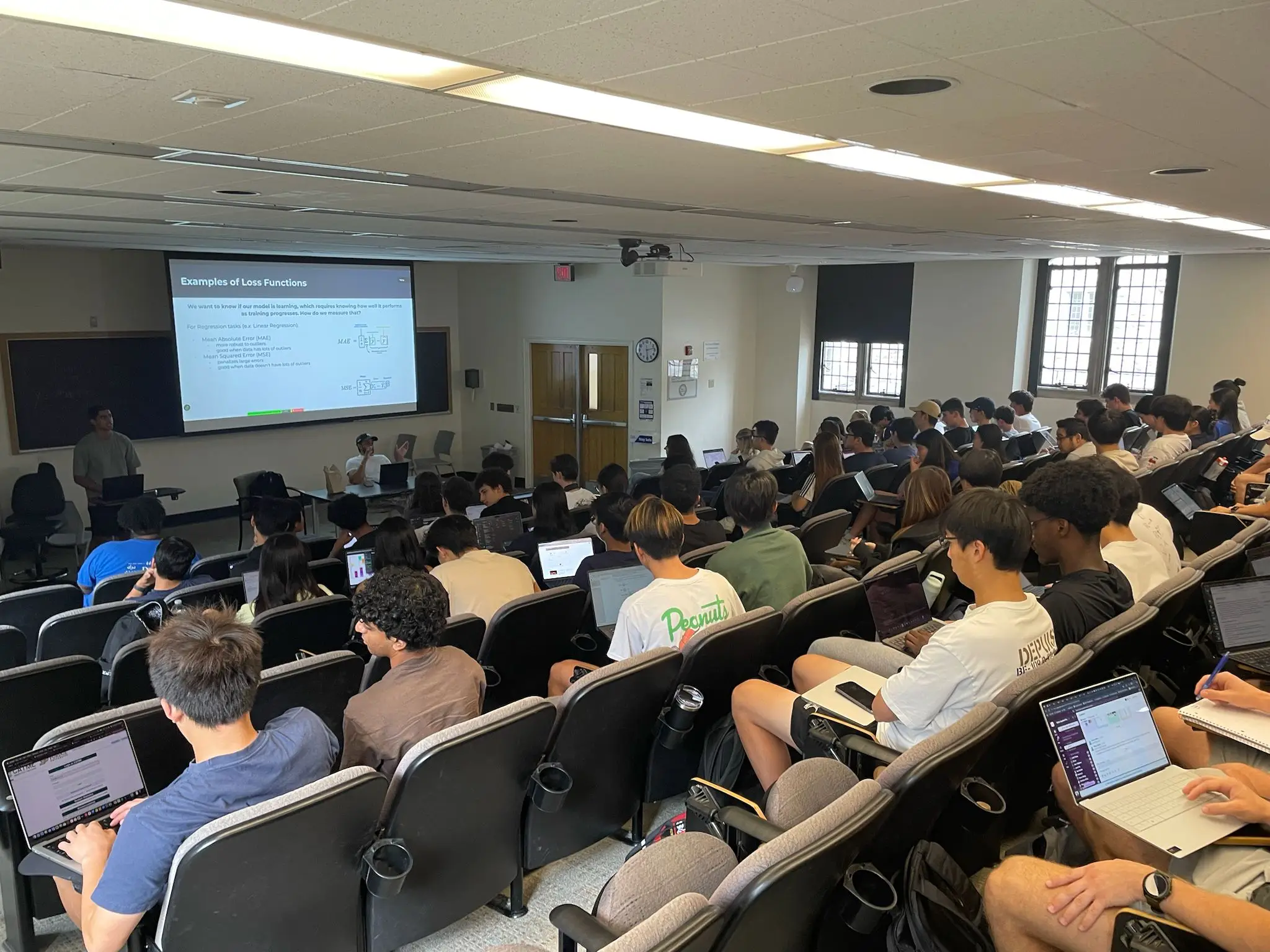
Missed last week's lecture? Catch up on Week 4.
Simple unsupervised + signal/time-series methods · Reinforcement learning
Watch past lectures
Missed a Saturday or want a refresher? Recordings go up on our YouTube channel after each week's workshop.
Subscribe on YouTubeThe 10-week syllabus
Each week pairs a workshop with hands-on work, building from classical methods to the architectures behind today's models.
- Week01Watch
Intuition & ML landscape
- Supervised vs unsupervised
- different problem types
- what ML can solve
- cool applications
- limitations (AGI, BCI, genetics)
Hands-onDiscuss examples; no coding yet
- Week02Watch
Math & metrics bootcamp
- Probability
- statistics
- loss functions
- evaluation metrics
Hands-onSmall exercises: compute accuracy, precision, recall, cross-entropy by hand/code
Optional reading- But what is cross-entropy?3Blue1Brown
Builds up the cross-entropy loss from probability, step by step.
- Neural Networks, Manifolds, and TopologyChris Olah
How networks reshape the manifold your data lives on until the classes pull apart.
- Week03Watch
Simple supervised classification
- KNN
- logistic regression
- decision trees
- Gini impurity
Hands-onTrain each on tabular data; compare decision boundaries
Optional reading- A Visual Introduction to Machine LearningR2D3
An animated walkthrough of how a decision tree chooses its splits.
- Week04Watch
Simple unsupervised + signal/time-series methods
- K-means
- PCA
- NMF
- FA
- HMM
- GFPA
- Granger causality
Hands-onCluster and decompose data; apply HMM/Granger to time series
Reinforcement learning
- Q-learning
- basic RL concepts
Hands-onGridworld Q-learning demo; maybe CartPole if time
Optional reading- Principal Component Analysis Explained VisuallySetosa
Interactive plots showing what PCA's components actually capture.
- Deep RL Course, Unit 2: Q-learningHugging Face
A beginner-friendly Q-learning walkthrough with code you can run.
- Week05Upcoming
Intro to deep learning + classical baselines
- MLP
- backprop
- random forest
- SVM
Hands-onBuild small MLP; compare with random forest/SVM on same dataset
Optional reading- Neural Networks (videos 1–4)3Blue1Brown
Neurons, gradient descent, and backpropagation, explained visually.
- Building a Neural Network from ScratchSamson Zhang
Builds and trains an MLP with only NumPy, deriving the math as it goes.
- Random ForestsBreiman, 2001
The original paper introducing random forests.
- Week06Upcoming
Convolution & image recognition
- Convolution
- image recognition
- YOLO
Hands-onTrain a small CNN; use pretrained YOLO for object detection
Optional reading- Conv Nets: A Modular PerspectiveChris Olah
An intuitive picture of convolutional layers as reusable feature detectors.
- You Only Look Once (YOLO)Redmon et al., 2016
The original YOLO paper: object detection in a single forward pass.
- Week07Upcoming
Sequences & attention before transformers
- Recurrent networks
- simple attention
- hard/soft attention
- QKR
- applications
- LSTM
Hands-onUse RNN/LSTM; visualize attention weights; discuss attention pre-transformers
Optional reading- Understanding LSTM NetworksChris Olah
The classic visual guide to how LSTM gates work.
- Neural Machine Translation by Jointly Learning to Align and TranslateBahdanau et al., 2014
The paper that introduced attention for translation, before transformers.
- Week08Upcoming
Transformers & modern sequence models
- Transformers
- transformer internals
- SSMs
Hands-onUse a pretrained transformer; overview SSMs
Optional reading- Attention Is All You NeedVaswani et al., 2017
The original transformer paper.
- Transformers and Attention (videos 6–8)3Blue1Brown
Embeddings, attention, and how transformers store facts, explained visually.
- Mamba: Linear-Time Sequence Modeling with Selective State SpacesGu & Dao, 2023
The state space model behind the recent push beyond transformers for long sequences.
- Week09Upcoming
Generative modeling
- AE
- VAE
- GAN
- diffusion
- flow matching
Hands-onTrain/generate with pretrained VAE/GAN/diffusion; explain flow matching conceptually
Optional reading- Auto-Encoding Variational BayesKingma & Welling, 2013
The original variational autoencoder (VAE) paper.
- Generative Adversarial NetworksGoodfellow et al., 2014
The original GAN paper.
- What are Diffusion Models?Lilian Weng
A thorough, well-illustrated walkthrough of how diffusion models work.
- Week10Upcoming
Applications & agents
- API
- Token
- MoE
- SWARM
- CLAW
- MCP
Optional reading- Building Effective AgentsAnthropic
Practical patterns for LLM agents, and when a simpler workflow is enough.
- ReAct: Synergizing Reasoning and Acting in Language ModelsYao et al., 2022
The paper behind the reason-then-act loop most LLM agents use.
Schedule and requirements
What the semester asks of you, and what you get back for it.
Structure
- Weekly cadence
- Workshops run Saturdays 12:00–1:00 pm in Social Sciences 139.
- Project sessions
- Dedicated project work sessions follow immediately after from 1:00–2:00 pm with mentor check-ins.
- Mentorship
- Each project team is paired with experienced DAML engineers who guide scoping, execution, and delivery.
Requirements
- Prerequisites
- Comfort with Python from CS 101/201 or equivalent. Prior ML exposure is helpful but not required.
- Attendance
- More than two unexcused absences removes eligibility for certification. Recordings are provided for approved conflicts.
- Deliverables
- A final project showcase judged by our DS Directors. Weighted scores across presentation and exam inform whether members pass our program.


